The Limits of Naive RAG
Most developers building Retrieval-Augmented Generation (RAG) systems start with a fundamental assumption: every user query requires a vector database lookup. This approach, often termed naive RAG, works acceptably in controlled environments or for simple applications. However, in production, this strategy quickly proves brittle and inefficient. It fails spectacularly in three key scenarios that expose its limitations.
First, simple queries, such as greetings like "Hi," or basic factual questions like "Who created this bot?", do not benefit from an expensive vector search. These queries can often be answered directly from a knowledge base, a pre-defined response, or even a simple LLM call without any retrieval. Forcing them through a vector pipeline adds unnecessary latency and computational cost.
Second, ambiguous queries represent a significant challenge. When a user's question is vague or open-ended, a naive RAG system might still perform a vector search. This often results in retrieving a broad range of documents, many of which are irrelevant to the user's true intent. The LLM then receives a diluted context window, filled with noisy or contradictory information, making it harder to generate a coherent and accurate response.
Third, out-of-domain queries are particularly problematic. These are questions for which the vector database contains no relevant documents. In a naive RAG system, the absence of relevant chunks forces the LLM to either state it cannot answer or, worse, hallucinate an answer based on its general training data, which might be outdated or inaccurate. This directly undermines the reliability of the RAG system.
These three failure modes highlight a critical gap: the assumption that all queries are equally complex and require the same retrieval strategy. Production systems demand more nuance.
Introducing Adaptive RAG with Dynamic Query Routing
Adaptive RAG addresses these shortcomings by acting as an intelligent orchestrator rather than a simple query-to-vector-search pipeline. The core principle is to first understand the intent of the user's query before deciding on the optimal retrieval strategy. This is achieved through dynamic query routing.
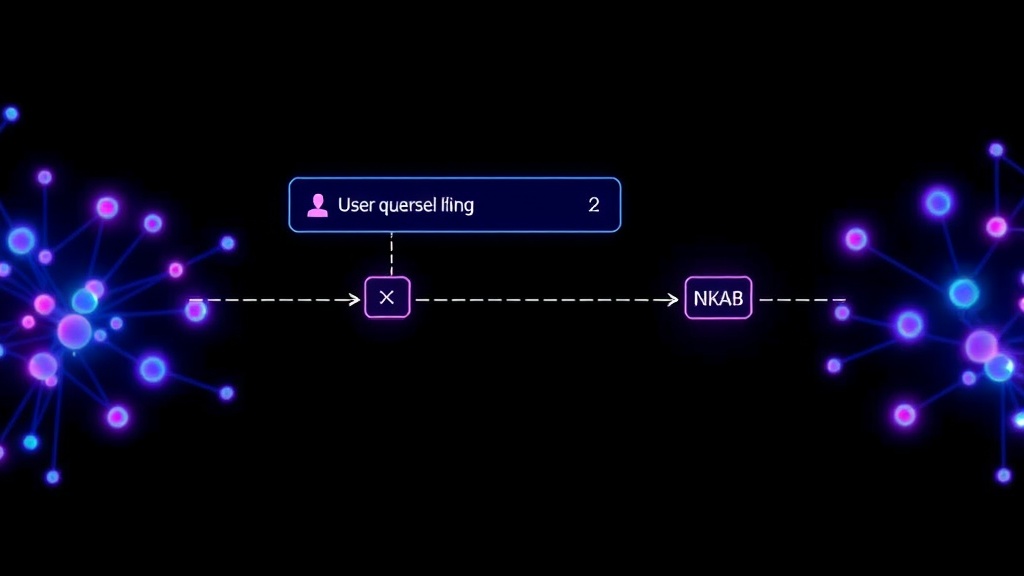
The process begins when a user query is received. Instead of immediately hitting a vector store, the query is first passed to an Intent Classifier Node. This node is responsible for analyzing the query and determining its nature. Based on this classification, the query is then routed to one of several potential downstream processing paths.
For simple queries, the system might bypass vector search entirely and provide a pre-canned response or use a lightweight LLM call. For ambiguous queries, the system might employ a more sophisticated retrieval strategy, perhaps retrieving a larger number of chunks and using a re-ranking model to filter them, or even prompting the user for clarification. For out-of-domain queries, the system can gracefully handle the lack of relevant information by stating it cannot answer, rather than attempting to force a response.
This dynamic routing mechanism ensures that computational resources are used efficiently and that the LLM receives the most relevant context for its task. It treats different query types with different processing needs, leading to more robust, accurate, and performant RAG applications.
Implementing Adaptive RAG with LangChain and FastAPI
Implementing Adaptive RAG involves integrating several components. The guide outlines a practical approach using popular tools in the AI development ecosystem: LangChain for orchestration, vector stores like Pinecone or Chroma for potential retrieval, and FastAPI for building the API endpoint.
The foundational element is the intent classifier. This can be built using a variety of techniques, ranging from simple keyword matching and regular expressions for basic cases, to more sophisticated machine learning models. For instance, a small, fine-tuned LLM or a dedicated classification model can be trained to categorize queries into buckets such as 'simple,' 'ambiguous,' 'out-of-domain,' or even specific knowledge domains.
Once the intent is classified, LangChain's capabilities can be leveraged to define different chains for each intent. A 'simple query' chain might involve a direct LLM call. An 'information retrieval' chain would then proceed to a vector store lookup, potentially followed by re-ranking or summarization steps before being passed to the final generation LLM. An 'out-of-domain' chain might simply return a polite refusal message.
FastAPI serves as the web framework to expose this adaptive RAG pipeline as a service. Developers can define API endpoints that receive user queries, pass them through the adaptive routing logic orchestrated by LangChain, and return the generated response. This allows for easy integration into existing applications.
For vector storage, the choice between Pinecone and Chroma depends on deployment needs. Pinecone offers a managed, scalable solution ideal for production environments, while Chroma is an open-source, embeddable option suitable for development or smaller-scale deployments.
The key takeaway is that adaptive RAG shifts the paradigm from a one-size-fits-all retrieval approach to a context-aware, intent-driven system. This makes RAG applications more resilient, efficient, and user-friendly in real-world scenarios.
Benefits of Adaptive RAG
Adopting an adaptive RAG strategy yields significant advantages over naive implementations. The most immediate benefit is improved performance and efficiency. By avoiding unnecessary vector searches for simple queries, latency is reduced, and computational costs are lowered. This is crucial for applications that need to handle a high volume of requests cost-effectively.
Secondly, accuracy and relevance are enhanced. By intelligently routing ambiguous queries and handling out-of-domain requests gracefully, the system ensures that the LLM receives cleaner, more pertinent context. This directly translates to more accurate and helpful responses, reducing the likelihood of hallucinations and irrelevant information.
Thirdly, user experience is elevated. Faster response times and more accurate answers lead to greater user satisfaction. Furthermore, the ability to intelligently handle queries that the system cannot answer prevents frustrating dead ends and builds trust in the application's capabilities.
Finally, scalability and maintainability are improved. An adaptive system is more flexible. As new types of queries emerge or as the knowledge base expands, the routing logic can be updated without overhauling the entire retrieval mechanism. This modularity makes the system easier to manage and scale.
What remains to be seen is how effectively these intent classifiers can be trained and maintained as user query patterns evolve over time. The accuracy of the classifier is paramount to the success of the entire adaptive strategy.