The Problem with Equal Shares
Imagine five identical servers behind a single load balancer. Logically, each should receive one-fifth of the incoming requests. Yet, one server might be redlining at 90% CPU utilization while another sits nearly idle, handling only a fraction of its potential. This common scenario highlights a critical flaw in traditional load balancing: an equal share of requests does not equate to an equal share of work. This disparity is amplified dramatically when dealing with the complex, variable demands of Artificial Intelligence workloads.
Traditional load balancers often rely on static algorithms like Round Robin or Least Connections. Round Robin simply cycles through servers sequentially, regardless of their current load or health. Least Connections directs traffic to the server with the fewest active connections, a metric that doesn't account for the computational intensity of individual requests. These fixed approaches worked adequately for simpler web applications where requests were relatively uniform. However, AI tasks, from training large language models to real-time inference for computer vision, involve vastly different computational footprints. A single AI inference request can consume orders of magnitude more resources than a standard HTTP request. Consequently, blindly distributing these varied workloads can lead to severe performance bottlenecks and inefficient resource allocation.
Introducing Adaptive Load Balancing
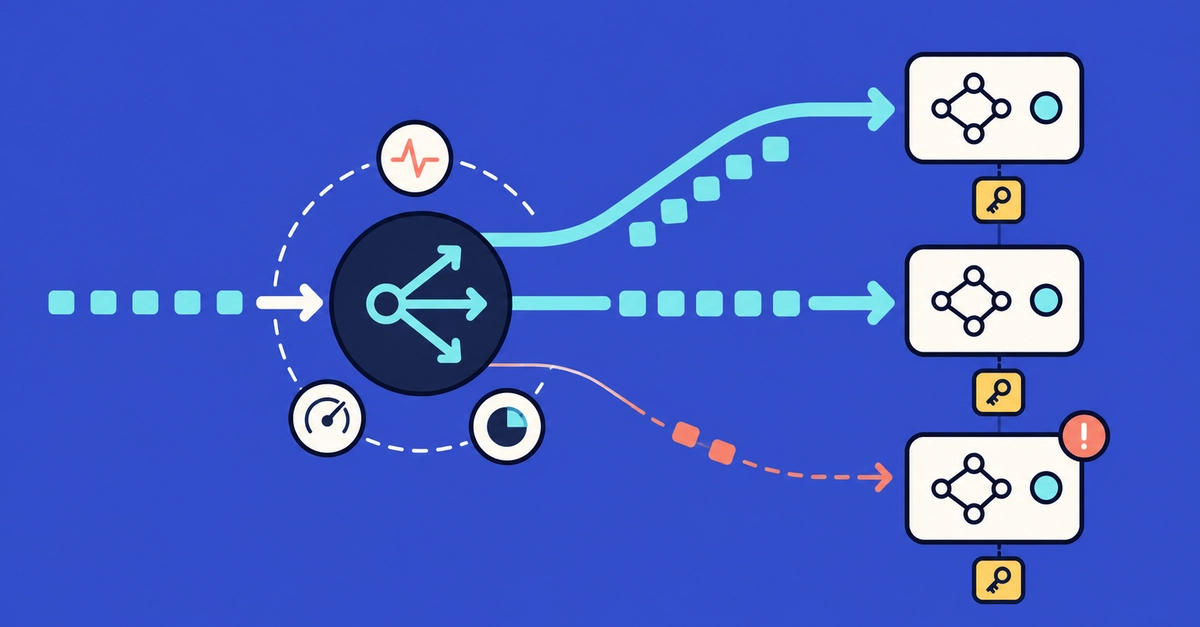
Adaptive load balancing, also known as intelligent or dynamic load balancing, fundamentally changes this paradigm. Instead of relying on predetermined distribution patterns, it employs live health signals to make routing decisions. These signals can include a server's current error rate, response latency, CPU utilization, memory usage, and network I/O. The load balancer continuously monitors these metrics for each backend server.
When traffic flows, the adaptive balancer dynamically scores each backend. Servers performing well—those with low latency, minimal errors, and manageable utilization—receive a higher score and thus a larger proportion of incoming traffic. Conversely, servers exhibiting signs of strain, such as high error rates or increasing latency, are temporarily de-prioritized, with their share of the traffic reduced. This dynamic shifting ensures that the workload is distributed not just evenly, but optimally, based on the real-time capacity and health of each server.
Think of it less like a traffic cop directing cars down predetermined lanes, and more like an air traffic controller dynamically assigning landing slots based on runway availability, wind speed, and aircraft performance. The goal is not just to move traffic, but to do so efficiently and without causing congestion on any single path.
Why AI Needs Adaptive Load Balancing Now More Than Ever
The rise of sophisticated AI models, particularly in areas like generative AI, machine learning inference, and complex data processing, has created a perfect storm for traditional load balancing. These workloads are characterized by extreme variability:
- Computational Intensity: A single inference request for a large language model can take seconds and consume significant CPU or GPU resources, whereas a typical web request might take milliseconds.
- Resource Spikes: Certain AI tasks, like batch processing or model training, can cause sudden, massive spikes in resource demand that overwhelm static distribution models.
- Varied Latency Requirements: Real-time AI applications (e.g., autonomous driving, fraud detection) demand ultra-low latency, while batch processing tasks can tolerate higher latency. A single load balancer must manage these diverse needs simultaneously.
- Model Updates and Drift: AI models are frequently updated or fine-tuned. During these processes, server performance can fluctuate unpredictably. Adaptive load balancing can gracefully shift traffic away from servers undergoing updates or experiencing performance degradation due to model drift.
Without adaptive load balancing, AI systems often suffer from:
- Underutilization of Resources: Powerful, expensive hardware sits idle because traffic is being shunted to overloaded servers.
- Performance Bottlenecks: Users experience high latency or timeouts because requests are hitting servers that cannot handle the computational load.
- Increased Costs: To compensate for inefficient distribution, organizations often over-provision hardware, leading to higher infrastructure costs.
- Unreliable AI Services: The inconsistent performance makes AI-powered applications unreliable, impacting user experience and business outcomes.
The Speed of Adaptation
A critical factor in adaptive load balancing is the speed at which it can react to changes. For AI inference, where low latency is paramount, the balancer must detect performance degradations and reroute traffic within milliseconds. This requires sophisticated monitoring agents on each server and a responsive load balancing engine. The ability to react quickly prevents cascading failures and ensures that user-facing AI applications remain responsive even under fluctuating demand.
The Broader Implications
The shift towards adaptive load balancing is not just about improving AI performance; it reflects a broader trend in infrastructure management. As systems become more complex and workloads more dynamic, static configurations are increasingly inadequate. Cloud-native architectures, microservices, and the pervasive use of AI demand infrastructure that can intelligently self-optimize. Adaptive load balancing is a key component of this intelligent infrastructure, enabling systems to operate more efficiently, reliably, and cost-effectively. As AI continues to integrate into more facets of business and technology, the need for sophisticated traffic management solutions like adaptive load balancing will only intensify.