The Allure and Illusion of Adam
Adam, the adaptive learning rate optimization algorithm, has become the de facto standard in deep learning. Its widespread adoption stems from its perceived simplicity and effectiveness across a broad range of tasks. Developers often reach for Adam as a default, assuming its adaptive nature will automatically navigate the complex loss landscapes of neural networks. This heuristic, however, is a dangerous oversimplification. While Adam excels in many scenarios, its underlying mechanisms can lead to spectacular failures if misunderstood and misapplied. The core issue lies not in Adam itself, but in the user's expectation and configuration of the algorithm.
At its heart, Adam combines the advantages of two other popular optimization algorithms: AdaGrad and RMSProp. AdaGrad adapts the learning rate for each parameter based on the historical sum of squared gradients, effectively reducing the learning rate for frequently updated parameters. RMSProp, on the other hand, uses an exponentially decaying average of squared gradients, providing a more responsive adaptation by giving more weight to recent gradients. Adam takes this a step further by maintaining exponentially decaying averages of both the past gradients (first moment) and the past squared gradients (second moment). This dual-moment estimation allows Adam to adapt the learning rate for each parameter individually, making it remarkably efficient in practice. It’s like having a personal trainer for each neuron, adjusting their workout intensity based on their past performance and current fatigue.
When Adam Stumbles: Failure Modes Unpacked
Despite its strengths, Adam is not a silver bullet. Its failure modes are often subtle and can manifest as slow convergence, suboptimal final performance, or outright divergence. One primary reason for failure is the misinterpretation of its hyperparameters, particularly beta1 and beta2, which control the decay rates of the moving averages. Default values, often set at 0.9 for beta1 and 0.999 for beta2, are derived from theoretical considerations and may not be optimal for every network architecture or dataset. Deviating too far from these defaults without a solid understanding can destabilize the optimization process.
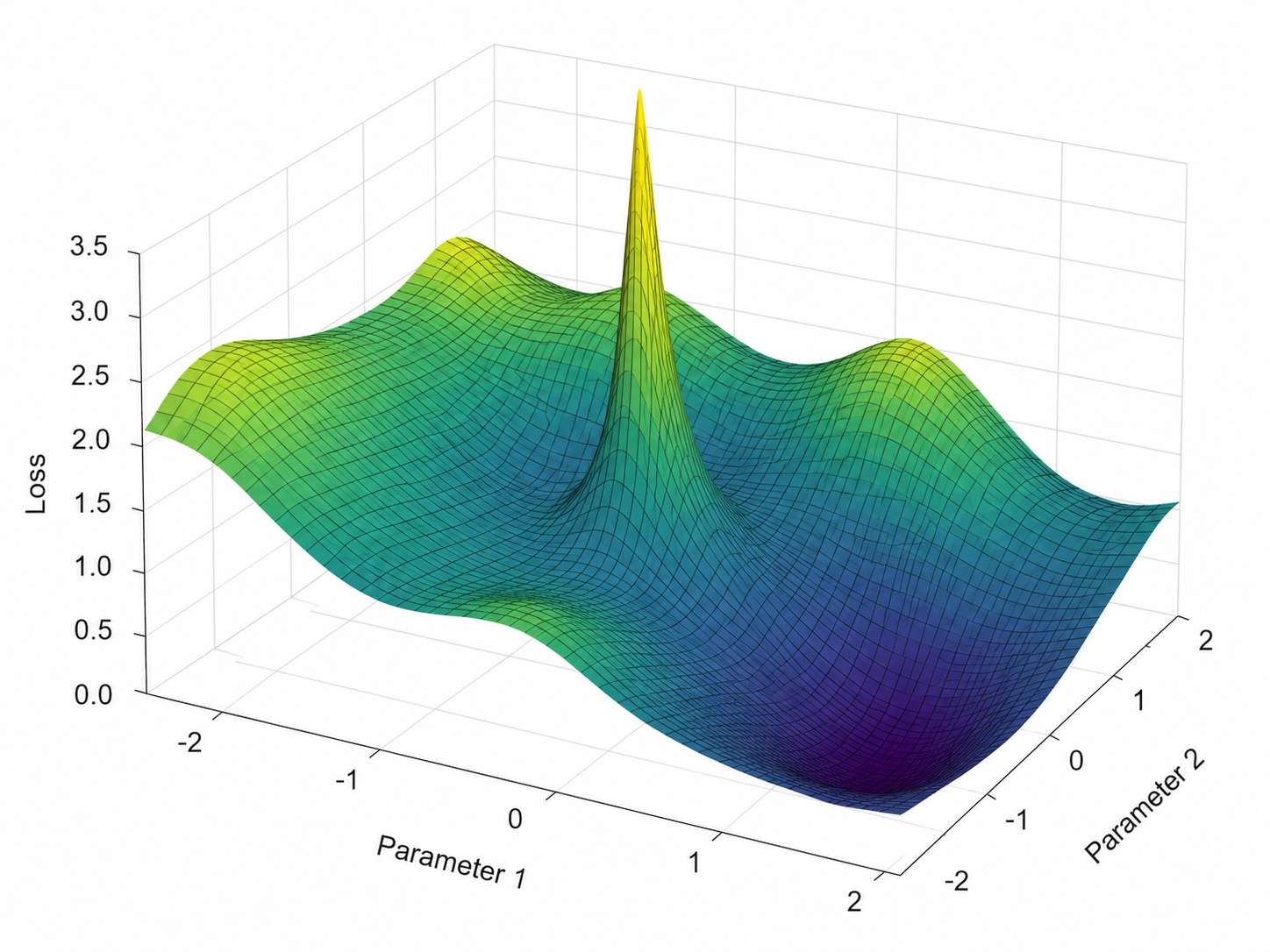
A more insidious problem is Adam's tendency to converge to poor local minima, especially in non-convex optimization problems common in deep learning. While Adam's adaptive learning rates help it escape shallow local minima, they can sometimes lead it astray, converging to a point that appears good locally but is far from the global optimum. This is often exacerbated by the fact that Adam's second moment estimate can become very small, effectively making the learning rate for certain parameters too large or unstable. This can be particularly problematic when dealing with sparse gradients or when the loss surface has sharp valleys.
Another critical failure point is the assumption that Adam is always the best choice. In certain scenarios, simpler optimizers like SGD with momentum can outperform Adam, especially when generalization is paramount. Studies have shown that Adam can sometimes converge to sharper minima, which are often associated with poorer generalization performance compared to the flatter minima found by SGD. This is akin to Adam finding a quick, efficient route that leads to a dead-end in terms of long-term goals, while SGD might take a slower, more meandering path that ultimately leads to a more robust destination.
Remedies and Best Practices for Adam
To avoid the pitfalls of Adam, a deeper understanding and careful configuration are essential. Firstly, treat Adam's hyperparameters as tunable parameters, not fixed constants. Experiment with different values for beta1 and beta2, especially if you observe training instability or poor convergence. A common adjustment is to slightly decrease beta1 (e.g., to 0.8 or 0.85) to reduce the influence of past gradients, which can help in cases where the optimizer gets stuck in suboptimal regions.
Secondly, consider using a learning rate scheduler in conjunction with Adam. While Adam adapts learning rates per parameter, a global learning rate scheduler can still be beneficial to gradually decrease the overall learning rate as training progresses, helping to fine-tune the model and settle into a good minimum. Techniques like learning rate decay or cyclical learning rates can be highly effective.
Thirdly, be aware of the potential for poor generalization. If your primary goal is to achieve the best possible performance on unseen data, carefully compare Adam's results against SGD with momentum. It might be necessary to train for longer with SGD, but the resulting model could generalize better. This often involves a trade-off between training speed and final model robustness.
Finally, monitor your training metrics closely. Look for signs of instability, such as oscillating loss or accuracy, or a plateau that seems too early. Visualizing the loss landscape, if feasible, can provide further insights. When Adam's loss starts to fluctuate wildly or diverge, it's a strong signal that the current configuration is not working. In such cases, consider reducing the learning rate, adjusting betas, or even switching optimizers.
Beyond the Defaults: A More Nuanced Approach
The temptation to simply "throw Adam at it" stems from its perceived robustness and ease of use. However, this approach ignores the nuanced dynamics of optimization in deep learning. Adam's adaptive nature is a powerful tool, but like any powerful tool, it requires skill and understanding to wield effectively. By delving into its failure modes and implementing thoughtful configuration strategies, developers can harness Adam's full potential and avoid the costly consequences of its misunderstanding. It’s not about discarding Adam, but about using it with intelligence, recognizing that the default settings are a starting point, not an endpoint.