Surprising Efficacy from Low-Cost RL Fine-Tuning
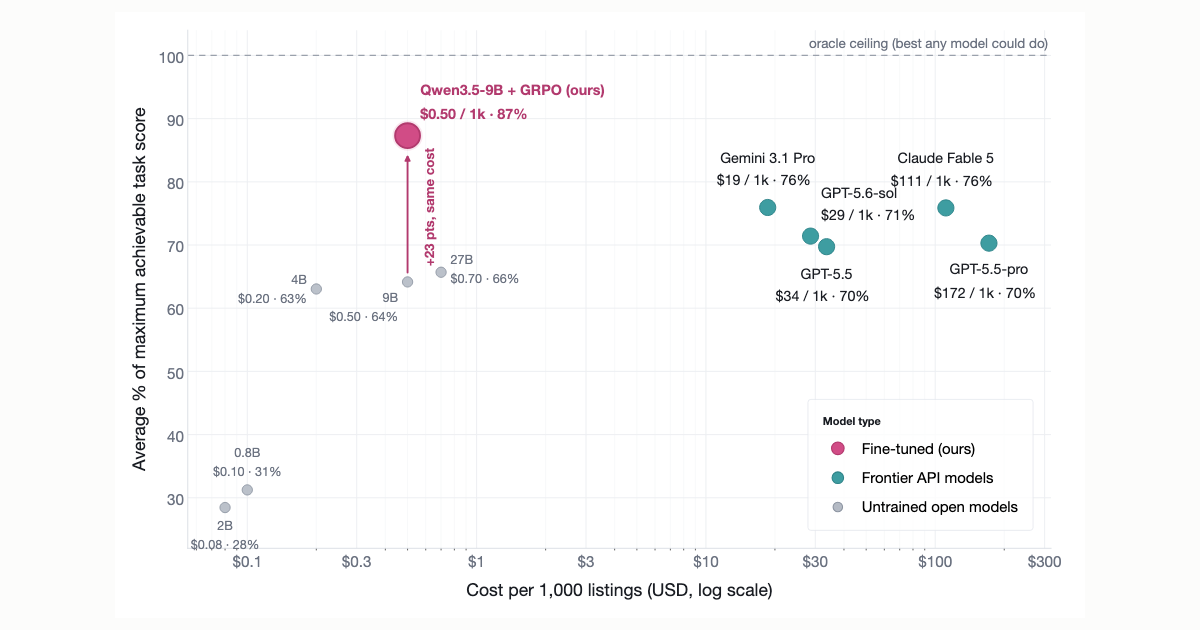
The landscape of large language models (LLMs) is often dominated by discussions of massive parameter counts and multi-million dollar training budgets. However, a recent development demonstrates that significant performance gains on specialized tasks can be achieved with remarkably little investment. A 9 billion parameter open-source model, fine-tuned using reinforcement learning (RL) for a mere $500, has surpassed the performance of leading frontier models on the challenging task of catalog review.
This achievement, detailed in a Hacker News discussion originating from Fermisense, directly challenges the assumption that state-of-the-art performance is exclusively the domain of the largest, most resource-intensive models. The core innovation lies not in the base model's size, but in the targeted application of RL to align its outputs with specific, nuanced human preferences inherent in catalog review.
Catalog review, particularly for e-commerce or content platforms, involves assessing items for compliance with guidelines, identifying policy violations, and ensuring quality. This requires a subtle understanding of context, subjective judgment, and the ability to generalize across a vast array of products and descriptions. Traditional supervised fine-tuning often struggles with these subjective elements, leading to models that are brittle or fail to capture the full spectrum of human evaluation.
The Fermisense approach, while not fully detailed in the available excerpt, leverages RL to learn from human feedback on the model's outputs. This is akin to teaching a model not just what is correct, but what is *preferred* by human reviewers. The $500 cost suggests an efficient data collection and training pipeline, likely involving a carefully curated dataset of human judgments on model-generated reviews or classifications.
The surprising detail here is not the modest investment, but the stark contrast in performance. Frontier models, often boasting hundreds of billions or even trillions of parameters and trained on petabytes of data, are expected to excel across a wide range of tasks. For a significantly smaller, open model to surpass them on a complex, judgment-heavy task like catalog review suggests a fundamental shift in how we can achieve high-performance AI.
This methodology implies that for tasks with well-defined, albeit complex, human preferences, RL fine-tuning can be a potent and cost-effective strategy. It democratizes the ability to achieve top-tier performance, moving beyond the exclusive reach of well-funded AI labs.
Implications for Open Models and Specialized AI
The success of this $500 RL fine-tune has profound implications for the open-source AI community and for businesses seeking to deploy AI for specific, high-stakes applications. Firstly, it validates the strategy of starting with a capable, openly available base model and investing in targeted alignment techniques rather than attempting to train a model from scratch.
This approach significantly lowers the barrier to entry for achieving specialized AI capabilities. Companies and researchers can now potentially achieve cutting-edge performance on tasks like content moderation, customer support evaluation, or product categorization without requiring massive computational resources or proprietary datasets. The focus shifts from raw scale to intelligent fine-tuning and preference alignment.
The $500 price point is particularly striking. It suggests that the data labeling or human feedback collection process was highly efficient, or that the RL training itself was remarkably optimized. This could involve techniques like direct preference optimization (DPO) or other RLHF (Reinforcement Learning from Human Feedback) variants that are known for their efficiency compared to older RL methods.
The ability to outperform frontier models on a specific, complex benchmark like catalog review also highlights the importance of task-specific evaluation. While frontier models aim for broad generalization, specialized models, even smaller ones, can achieve superior performance when meticulously trained and aligned for a particular domain. This begs the question of how many other critical business functions could be optimized with similar low-cost, high-impact fine-tuning efforts.
The open-source nature of the base model is also critical. It means that the underlying architecture and weights are accessible, allowing for greater transparency and the potential for further research and development by the community. This contrasts with proprietary frontier models, where the internal workings and training methodologies remain opaque.
The Future of AI Alignment and Efficiency
This development signals a potential paradigm shift in AI development, moving towards more efficient and targeted alignment strategies. The era of simply scaling up models might be giving way to an era where sophisticated fine-tuning techniques, particularly RL-based methods, unlock the true potential of existing architectures.
For developers, this means that understanding and implementing RL for preference alignment is becoming an essential skill. The ability to gather and utilize human feedback effectively, even at a small scale, can yield disproportionately large performance improvements. The focus will be on data quality and the sophistication of the alignment algorithm over sheer model size.
Founders and product managers should view this as an opportunity. Instead of waiting for larger, more general models to eventually address their niche problems, they can explore fine-tuning existing open models for their specific use cases. The cost-effectiveness demonstrated here could enable startups and smaller companies to build AI-powered features that were previously only accessible to tech giants.
What nobody has addressed yet is the long-term scalability and robustness of these low-cost RL fine-tuned models. While they excel on specific benchmarks, how do they fare when faced with adversarial inputs or entirely novel scenarios not covered in the fine-tuning data? Understanding the failure modes and generalization capabilities of these highly specialized, efficiently trained models will be crucial for their widespread adoption in critical systems.
Ultimately, this $500 RL fine-tune represents a significant step towards more accessible, efficient, and performant AI. It proves that innovation in AI development doesn't always require the largest budgets; it often requires clever application of advanced techniques to unlock the latent capabilities of existing models.