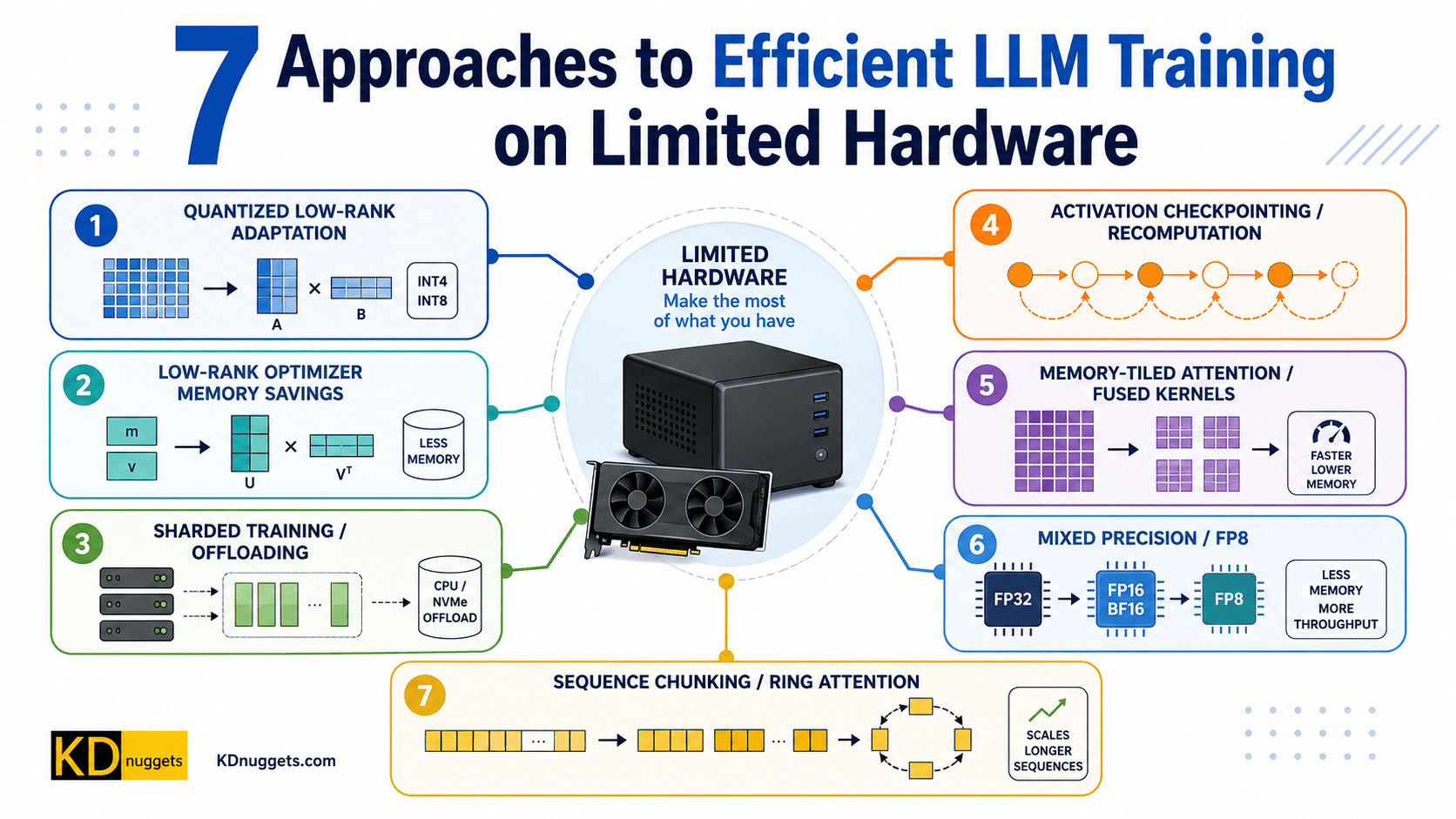
Efficient LLM Training on Limited Hardware
Training large language models (LLMs) typically demands substantial computational resources, often exceeding the capabilities of consumer-grade hardware. The sheer size of these models, coupled with the vast datasets they process, leads to significant memory requirements. However, several engineering techniques can drastically reduce these demands, making LLM training accessible even on GPUs with limited VRAM. This article outlines seven key approaches for efficient LLM training on such hardware.
1. Gradient Accumulation
Gradient accumulation is a technique that allows for larger effective batch sizes than what can fit into GPU memory at once. Instead of computing gradients for the entire batch and updating the model weights immediately, gradients are computed for smaller mini-batches and accumulated over several steps. The model weights are then updated only after a specified number of mini-batches have been processed, simulating a larger batch size. This method effectively trades off computation time for reduced memory usage, as only the gradients for a single mini-batch need to be stored at any given moment, rather than the gradients for the entire large batch.

2. Mixed Precision Training
Mixed precision training utilizes a combination of 16-bit (half-precision) and 32-bit (single-precision) floating-point formats during model training. Most operations, such as forward and backward passes, are performed using 16-bit precision, which requires half the memory of 32-bit precision. Crucially, certain operations that are sensitive to numerical stability, like weight updates, are still performed in 32-bit precision. This approach can significantly reduce memory footprint and speed up computation, as modern GPUs often have specialized hardware (Tensor Cores) optimized for 16-bit operations. Tools like NVIDIA's Automatic Mixed Precision (AMP) simplify the implementation of this technique.
3. Gradient Checkpointing (Activation Recomputation)
Gradient checkpointing is a memory-saving technique that involves selectively discarding intermediate activations during the forward pass and recomputing them during the backward pass. In standard backpropagation, all intermediate activations are stored to compute gradients. Gradient checkpointing trades computation for memory by storing only a subset of these activations. When gradients are needed for a specific layer or block, the computation is re-run from the nearest saved activation point. This drastically reduces the memory required to store activations, which is often a major bottleneck, at the cost of increased training time due to the recomputation.
4. Parameter Efficient Fine-Tuning (PEFT) Methods
While not strictly for initial training, PEFT methods are crucial for adapting large pre-trained models on limited hardware. Techniques like LoRA (Low-Rank Adaptation), Adapters, and Prefix Tuning freeze most of the pre-trained model's parameters and introduce a small number of trainable parameters. These new parameters are typically much smaller than the original model's weights. For instance, LoRA injects trainable low-rank matrices into specific layers. This dramatically reduces the number of parameters to train and store gradients for, making fine-tuning feasible on consumer GPUs. Adapters insert small, trainable feed-forward networks between existing layers.
5. Offloading Techniques
Offloading involves moving model parameters, gradients, or optimizer states from GPU memory to CPU memory or even disk when they are not actively being used. This is particularly effective for very large models where even with other optimizations, the full model and its associated states cannot fit into GPU VRAM. Techniques like ZeRO (Zero Redundancy Optimizer) stages, especially Stage 3, distribute model states across multiple devices (including CPUs). CPU offloading can significantly increase training time due to the slower data transfer speeds between CPU and GPU, but it enables training of models that would otherwise be impossible on the given hardware.
6. Model Parallelism and Pipeline Parallelism
Model parallelism involves splitting a single large model across multiple devices. Each device holds a portion of the model's parameters. Data parallelism, the more common approach, replicates the model on each device and splits the data. Model parallelism, however, is essential when a model is too large to fit on a single GPU. Pipeline parallelism is a form of model parallelism where layers of the model are distributed across different devices in a sequential pipeline. Data is fed through this pipeline, with each device processing its assigned layers. This requires careful scheduling to minimize idle time on devices.
7. Quantization-Aware Training (QAT)
Quantization reduces the precision of model weights and activations to lower bit-widths (e.g., 8-bit integers). Quantization-aware training simulates the effect of quantization during the training process itself. This means that while the model is trained, it is aware of the precision reduction that will occur during inference. This helps to mitigate the accuracy loss that can sometimes result from aggressive quantization. QAT involves quantizing weights and activations during the forward and backward passes, allowing the model to learn to be robust to these lower precision representations. While primarily an inference optimization, QAT can also reduce memory usage during training by enabling lower precision storage of weights and activations.
By strategically combining these techniques, developers can overcome hardware limitations and train sophisticated large language models on consumer GPUs, democratizing access to powerful AI capabilities.