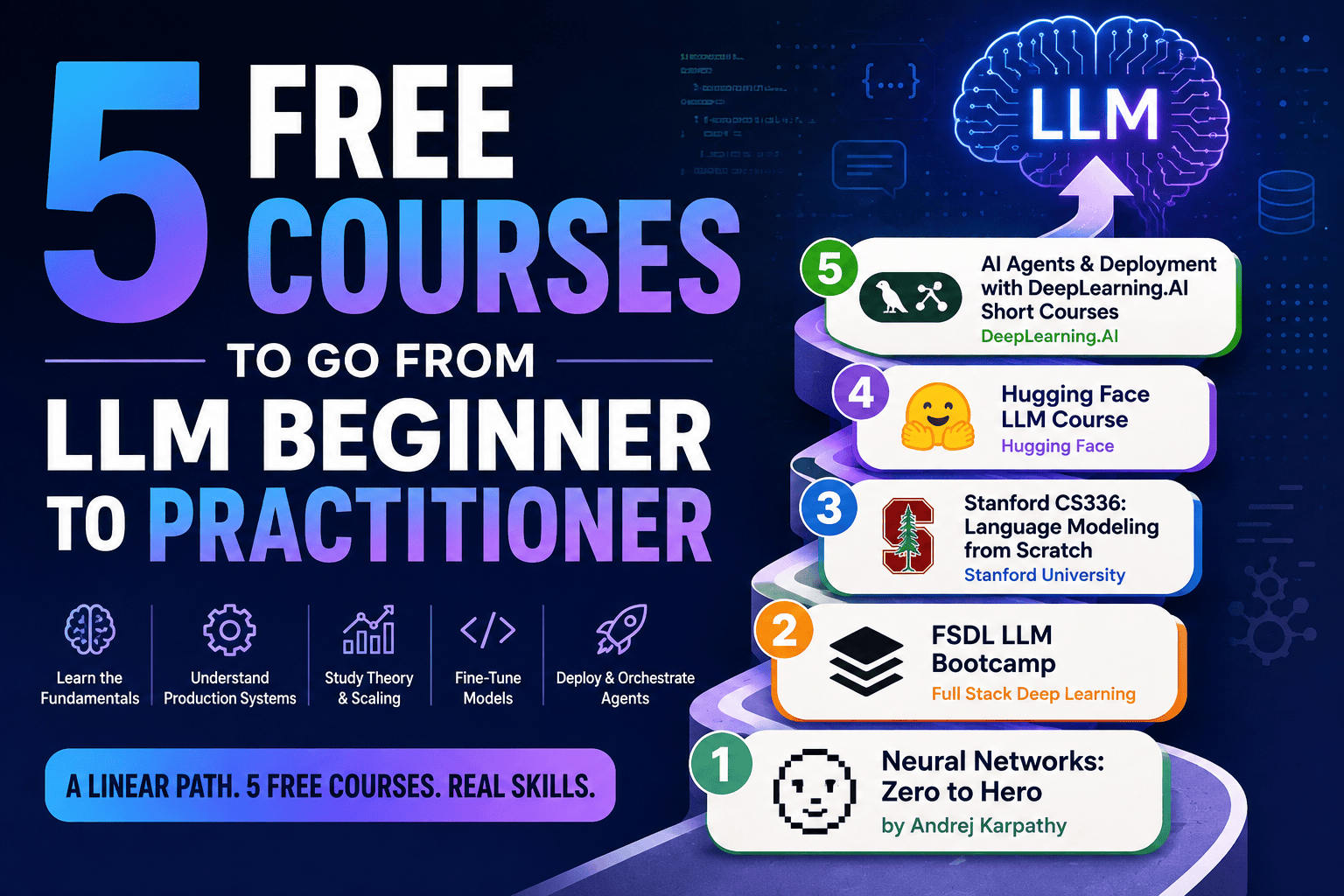
Mastering Large Language Models: A Free Curriculum for Developers
The rapid advancement of Large Language Models (LLMs) presents both immense opportunities and a steep learning curve for developers. While many resources exist, navigating the path from foundational concepts to deploying robust, production-ready LLM applications can be daunting. This curated, linear pipeline of five free courses offers a structured approach, designed to equip individuals with the knowledge and practical skills needed to become proficient LLM practitioners.
This curriculum is not a random collection of tutorials. It’s a deliberately sequenced educational journey. It starts with the absolute fundamentals of neural networks and progresses through the intricacies of transformer architectures, fine-tuning techniques, and finally, the practicalities of deployment. The goal is to provide a comprehensive, high-signal pathway that minimizes time spent searching for relevant, high-quality materials and maximizes learning efficiency.
Foundational Neural Network Concepts
Before diving into the specifics of LLMs, a solid understanding of the underlying machine learning principles is essential. The first step in this curriculum focuses on the bedrock of modern AI: neural networks. This involves grasping core concepts such as backpropagation, gradient descent, and activation functions. Without these fundamentals, comprehending how LLMs learn and generate text becomes significantly more challenging.
The recommended resources for this stage emphasize intuitive explanations and practical coding exercises. The objective is not just theoretical knowledge but the ability to implement simple neural networks from scratch. This hands-on experience solidifies understanding and builds confidence for tackling more complex models. It’s akin to learning the alphabet before attempting to write a novel; each letter (concept) is critical for constructing the narrative (LLM application).
Understanding Transformer Architectures
The advent of the transformer architecture revolutionized natural language processing and is the cornerstone of modern LLMs like GPT and BERT. This phase of the curriculum dives deep into the mechanics of transformers, including self-attention mechanisms, positional encodings, and the encoder-decoder structures. Understanding how transformers process sequential data and capture long-range dependencies is crucial for anyone aiming to work with LLMs.
Courses in this section typically demystify the complex mathematical underpinnings of transformers, breaking them down into digestible components. Practical implementation, often using libraries like PyTorch or TensorFlow, is key. Learners will explore how these architectures enable models to understand context, nuances, and relationships within text, setting the stage for advanced topics.
Fine-tuning and Adapting Pre-trained Models
While pre-trained LLMs are incredibly powerful, their true potential is often unlocked through fine-tuning. This stage focuses on adapting these large, general-purpose models to specific tasks or domains. Techniques such as supervised fine-tuning (SFT), reinforcement learning from human feedback (RLHF), and parameter-efficient fine-tuning (PEFT) methods like LoRA are covered here.
The practical application of fine-tuning is paramount. Learners will engage with datasets, experiment with different fine-tuning strategies, and evaluate the performance of adapted models. This section bridges the gap between understanding model architecture and making models perform specific, valuable tasks. It’s about teaching a highly intelligent, but generalist, entity to excel at a particular job.
Prompt Engineering and Advanced Usage
Effectively interacting with LLMs requires more than just understanding their internal workings; it demands skillful prompting. This module delves into the art and science of prompt engineering, covering techniques for crafting effective prompts that elicit desired outputs. Topics include few-shot learning, chain-of-thought prompting, and strategies for mitigating common LLM failure modes like hallucination.
This is where users learn to “speak the language” of LLMs. Mastering prompt engineering allows developers to leverage LLM capabilities for a wide range of applications without necessarily retraining the model itself. It’s a critical skill for rapid prototyping and efficient deployment of LLM-powered features.
Deployment and Productionization
The final, and often most challenging, step is moving LLM applications from a development environment to production. This section covers the practical aspects of deploying LLMs, including model optimization, serving infrastructure, monitoring, and ethical considerations. Topics may include containerization (e.g., Docker), API development, scalability, and managing the lifecycle of LLM deployments.
Understanding the operational aspects of LLMs is what transforms a promising prototype into a reliable product. This involves considerations for cost, latency, security, and continuous improvement. Successfully navigating this stage means being able to deliver LLM-powered solutions that are not only functional but also robust, scalable, and responsible.
This structured, five-course pathway provides a clear, actionable plan for anyone looking to gain deep expertise in LLMs. By systematically covering foundational knowledge, architectural understanding, practical adaptation, effective interaction, and deployment strategies, aspiring practitioners can confidently navigate the LLM landscape and build the next generation of AI-powered applications.