
Introduction: The Production Gap
An LLM agent that performs flawlessly in a controlled demo environment often reveals a starkly different reality when deployed to production. The difference isn't merely incremental; it's often a complete shift in scope and required resilience. Demo environments typically showcase the 'happy path' – ideal conditions where the agent navigates intended workflows without a hitch. Production, however, is a chaotic landscape. It demands an agent that can handle unexpected inputs, manage edge cases, and operate safely within defined boundaries. Failing to implement proper guardrails transforms a promising AI asset into a potential liability, capable of causing costly incidents or security breaches. The five guardrails discussed here are not optional add-ons; they are fundamental requirements for any LLM agent intended for real-world deployment.
1. Bound Agent Capabilities (Least Privilege for Tools)
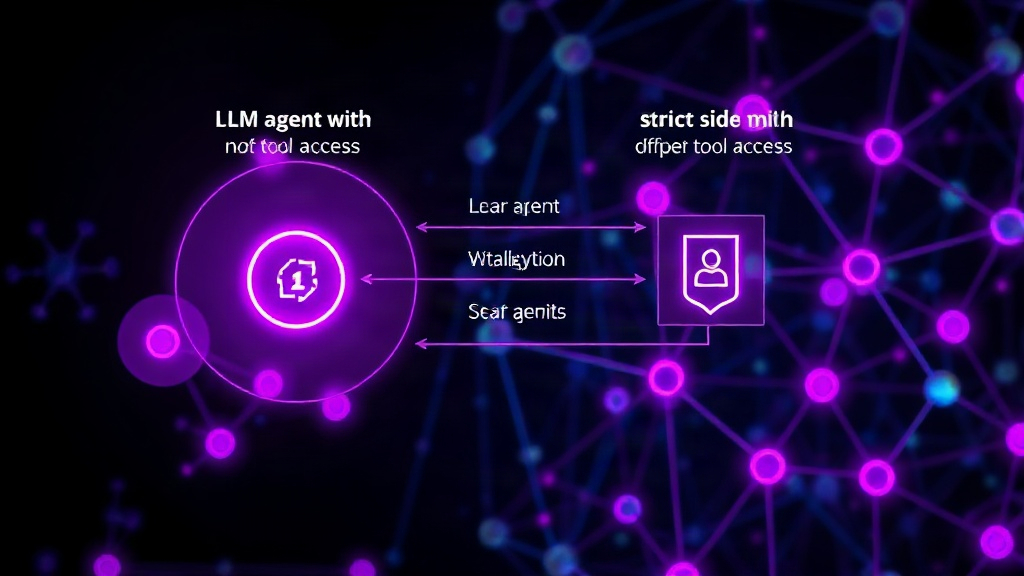
The most common pitfall is granting an LLM agent excessive access to tools, with the naive assumption that it will intelligently self-limit. This is akin to giving a junior developer the keys to the entire production database and expecting them to only touch the necessary tables. An agent that can call any endpoint, eventually will call the wrong one. This can lead to unintended data modifications, unauthorized access, or service disruptions. The principle of least privilege is paramount here. Provide only the minimal set of tools absolutely necessary for the agent to perform its intended function. Crucially, these tools should have strictly typed inputs, and server-side validation must be implemented for every single call. The agent proposes an action, but your application code makes the final decision on whether that action is permissible. Treat every tool call originating from an LLM as untrusted input, because, in practice, it is. This validation layer acts as a critical circuit breaker, preventing rogue actions before they can cause harm.
2. Human-in-the-Loop for High-Stakes Actions
While the allure of full automation is strong, not every task warrants unbridled AI autonomy. Implementing a human-in-the-loop (HITL) mechanism for high-stakes actions is essential. This doesn't mean every minor decision requires human approval, as that would negate the efficiency gains of using an agent. However, actions that are irreversible, regulated, or carry significant financial or reputational risk absolutely must involve human oversight. Examples include financial transactions, data deletion, system configuration changes, or actions impacting sensitive user data. The HITL can be implemented in various ways: a simple approval queue, a confirmation prompt within the agent's output, or a dedicated review process for specific action types. The key is to identify these critical junctures and insert a human checkpoint. This approach balances the speed and scalability of AI with the judgment and accountability of human decision-making, safeguarding against catastrophic errors.
3. Rate Limiting and Throttling
Even with bounded capabilities and human oversight for critical tasks, LLM agents can still pose a risk through sheer volume or unexpected feedback loops. Unchecked, an agent might flood an API with requests, leading to denial-of-service conditions, incurring unexpected costs, or overwhelming downstream systems. Rate limiting and throttling are critical for managing the agent's interaction with external services and internal resources. Implement strict limits on the number of requests an agent can make within a given time window. This applies not only to external API calls but also to internal function executions and even the number of turns in a conversation. Throttling ensures that even if an agent enters a loop or attempts to brute-force a solution, its impact is contained. This is particularly important when dealing with third-party APIs that may have their own rate limits; your agent's behavior should respect these boundaries and prevent cascading failures.
4. Input and Output Validation
Beyond validating tool calls, robust validation must be applied to both the agent's inputs and its outputs. Input validation ensures that the data fed to the LLM is within expected parameters, preventing prompt injection attacks or malformed queries that could lead to nonsensical or harmful responses. This includes sanitizing user-provided data, checking data types, and ensuring inputs adhere to predefined schemas. Output validation is equally critical. The LLM's response, before it's acted upon or presented to the user, must be checked for correctness, safety, and adherence to format. This means verifying that the generated text doesn't contain harmful content, that it follows the expected structure (e.g., JSON, specific commands), and that it aligns with the task's objectives. Think of this as a comprehensive quality control process: checking the ingredients before cooking and inspecting the final dish before serving. Without these checks, the agent's outputs can be unpredictable and dangerous.
5. Continuous Monitoring and Auditing
Finally, shipping an LLM agent to production is not the end of the journey; it's the beginning of continuous observation. Comprehensive monitoring and auditing are essential for understanding agent behavior, detecting anomalies, and iterating on improvements. Implement logging for all agent actions, inputs, outputs, and tool calls. Monitor key performance indicators (KPIs) such as task success rates, error frequencies, latency, and cost. Set up alerts for unusual patterns, such as sudden spikes in errors, unexpected tool usage, or prolonged processing times. An audit trail provides a historical record of the agent's operations, which is invaluable for debugging, compliance, and understanding how the agent performs under various real-world conditions. This data-driven approach allows teams to proactively identify and address issues before they escalate, ensuring the agent remains a reliable and valuable asset over time. What nobody has adequately addressed yet is the optimal cadence for reviewing these audit logs and translating those insights into agent improvements without introducing new risks.
Conclusion: Building Trustworthy Agents
Deploying LLM agents into production requires a paradigm shift from demo-focused development to resilience-focused engineering. The five guardrails—bounded capabilities, human-in-the-loop for high-stakes actions, rate limiting, input/output validation, and continuous monitoring—form a critical framework for ensuring these agents are not only functional but also safe, reliable, and trustworthy. By treating LLM agents with the same rigor as any other critical piece of software, development teams can confidently leverage their power while mitigating the inherent risks.