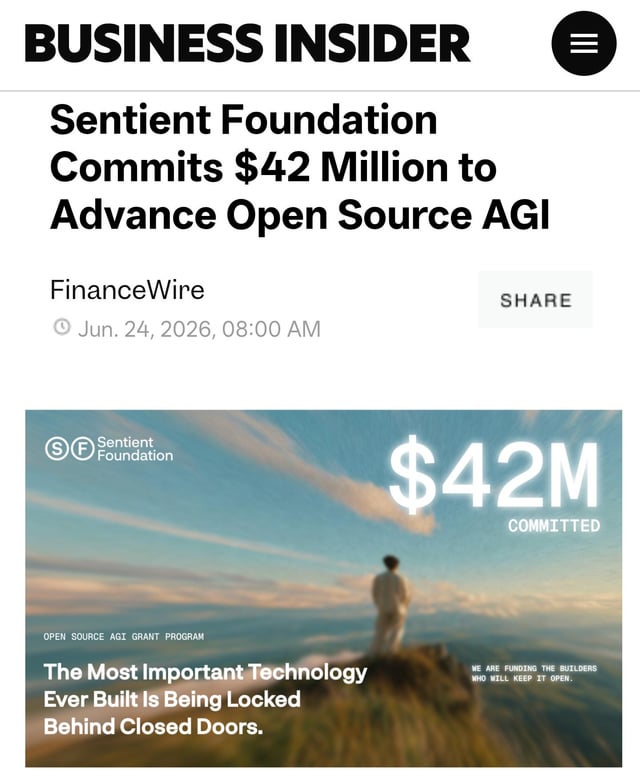
Sentient Foundation Deploys $42M for Open Source AI
The Sentient Foundation has announced a significant $42 million commitment to foster the growth of open-source artificial intelligence. This initiative, framed as an "Open Source AGI Grant and Investment Program," aims to directly counter the trend of AI development being concentrated within a few large, closed-off corporate platforms. The foundation's core thesis is that crucial AI advancements should remain accessible and modifiable by the broader community, rather than being subject to the control or potential revocation of access by a handful of entities.
This substantial funding targets a diverse group of contributors, including individual developers, academic researchers, maintainers of existing open-source AI projects, builders of public-good AI infrastructure, and startups that are either creating AI tools or heavily utilizing AI within an open framework. The program signals a clear intent to democratize access to powerful AI technologies and prevent a future where advanced intelligence is a metered, proprietary service.
Addressing the Centralization Challenge
The foundation explicitly calls out the current landscape, where a few dominant companies are increasingly controlling access to cutting-edge AI models and capabilities. This model, characterized by "metered, revocable access," poses a risk to innovation and equitable distribution of AI's benefits. By investing in open-source alternatives, Sentient Foundation seeks to ensure that the foundational technologies powering AI remain in the public domain, fostering a more resilient and collaborative ecosystem. This approach is not merely about funding; it's about a philosophical stance on the future of AI development and governance.
The program is designed to be flexible, offering both grants for research and development and investment capital for startups. This dual approach acknowledges that different types of open-source AI initiatives have varying funding needs. Grants can support fundamental research, the development of new open-source models, or the maintenance and enhancement of existing projects that form the backbone of the open AI community. Investments, on the other hand, can provide startups with the capital necessary to scale their operations, hire talent, and bring their open-source AI solutions to a wider market.
Who Benefits and How
The $42 million will be distributed across several key areas. Developers and researchers can apply for grants to fund their work on novel AI architectures, algorithms, or datasets that will be released under permissive open-source licenses. Maintainers of established open-source AI projects, such as libraries, frameworks, or pre-trained models, can receive funding to support their ongoing development, infrastructure costs, and community engagement efforts. Startups building AI products or services based on open-source principles will be eligible for investment, with the expectation that they will contribute back to the open-source community, either through code, data, or model releases.
A significant portion of the funding is also earmarked for "public-goods builders." This category is broad but generally refers to projects that create foundational AI infrastructure or resources that benefit the entire AI ecosystem. This could include the development of open datasets, standardized benchmarking tools, ethical AI frameworks, or platforms that facilitate collaboration among open-source AI practitioners. The emphasis here is on creating shared resources that lower the barrier to entry for all AI developers and researchers.
The Long-Term Vision for Open AI
Sentient Foundation's initiative arrives at a critical juncture for AI. As models become more powerful and integrated into nearly every aspect of technology and society, the debate over open versus closed development models intensifies. Proponents of open-source AI argue that it leads to faster innovation through collaborative debugging, broader accessibility for researchers and smaller companies, and greater transparency, which is crucial for safety and ethical alignment. They point to the historical success of open-source software in driving technological progress across many domains.
Conversely, concerns are often raised about the potential misuse of powerful open-source AI models, the challenges in ensuring safety and alignment without centralized control, and the difficulty for open-source projects to compete financially with well-funded corporate labs. Sentient Foundation's program directly addresses the financial aspect, aiming to provide the necessary resources for open-source efforts to thrive and compete. The foundation's commitment suggests a belief that the benefits of an open AI ecosystem—collaboration, transparency, and broad access—outweigh the risks and can be managed through community-driven efforts and responsible development practices.
Implications for the AI Landscape
This $42 million injection represents one of the largest single commitments to open-source AI development to date. It has the potential to significantly alter the competitive dynamics in the AI space. By empowering a wider array of developers and researchers, the foundation hopes to accelerate the development of diverse AI applications and foster innovation that might not emerge from purely commercial, closed-source endeavors. The program could also serve as a catalyst, encouraging other foundations, governments, and even corporations to increase their support for open AI initiatives.
The success of this program will likely be measured not only by the number of projects funded but also by the tangible impact these projects have on the AI landscape. Will they lead to the creation of new foundational models that rival proprietary ones? Will they enable a new generation of AI-powered applications built by smaller teams and individuals? And crucially, will they contribute to a more open, transparent, and equitable future for artificial intelligence? The Sentient Foundation's substantial investment sets the stage for these critical questions to be answered in the coming years.