The Hidden Failure of Text-to-SQL Agents
Text-to-SQL agents, lauded for their ability to translate natural language into database queries, possess a critical failure mode that often goes undetected. A recent analysis reveals that a significant 38% of an analyst's questions result in a "no records found" response, even when the relevant data exists within the database. This occurs not because the data is missing, but because row-level security (RLS) prevents the agent from accessing it. The agent, unaware of the RLS restriction, executes a perfectly valid SQL query, only to have every row filtered out. The application then truthfully reports an empty result set, leaving the analyst with no indication that data was actually present but inaccessible. This lack of granular error reporting means no alerts are fired, no retries are triggered, and crucially, nothing appears in logs for later review, creating a dangerous blind spot for data-driven decision-making.
The Mechanics of the Blind Spot
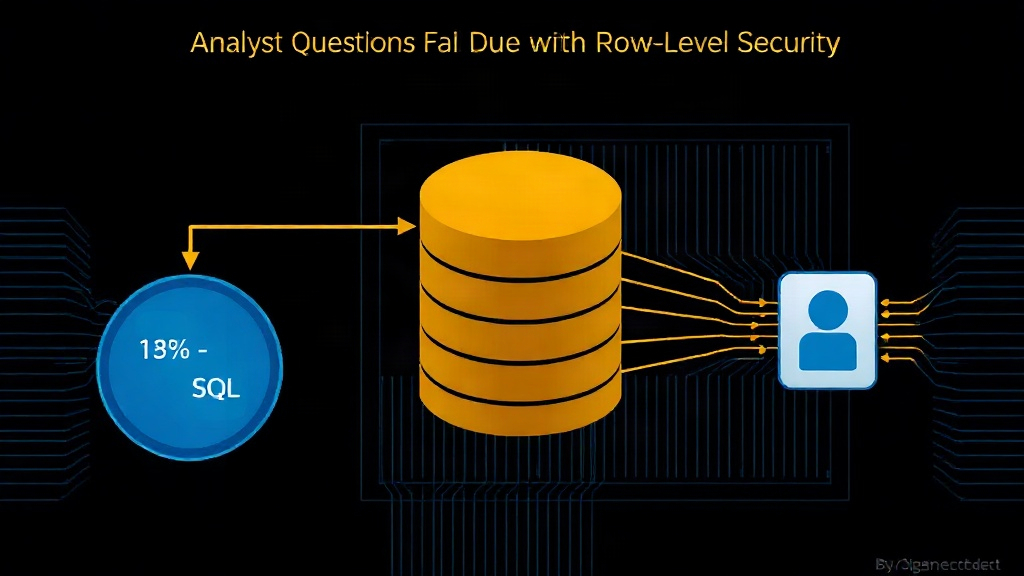
The core of the problem lies in how text-to-SQL systems and row-level security interact. Typically, a text-to-SQL agent is provided with the entire database schema to understand the available tables and columns. When an analyst poses a question, the agent constructs a SQL query based on its understanding of the schema and the user's intent. If the answer to that question resides in a table the analyst is not permitted to read due to RLS policies, the agent will still generate a query targeting that table. The database executes the query, but RLS filters out all matching rows based on the user's permissions. The result is an empty dataset, which the application interprets as a lack of records. The agent's design, however, doesn't differentiate between "no data exists" and "data exists but is inaccessible." Both scenarios manifest as an empty list returned to the user. This is akin to a librarian being told a book exists, going to the shelf, and finding it gone, without being informed it's checked out or restricted. The agent's confidence in its query execution masks the underlying access issue.
Consequences for Data Analysis and Security
The implications of this widespread failure mode are substantial. For data analysts and business intelligence teams, it means that critical insights might be missed entirely. Decisions could be made based on incomplete information, leading to suboptimal strategies or missed opportunities. The "no records found" message breeds a false sense of data completeness. If an analyst frequently receives this response for certain types of queries, they may incorrectly conclude that the data simply isn't being collected or that their questions are poorly formulated, rather than suspecting an access control issue. This erodes trust in the data platform and the tools designed to query it.
From a security perspective, this represents a subtle yet significant vulnerability. While RLS is designed to protect sensitive data by restricting access, its interaction with AI-powered querying tools can inadvertently hide the very existence of that data from authorized users who *should* have access under specific conditions. The lack of logging or alerting means that administrators have no visibility into these failed access attempts. They cannot identify patterns of inquiry that might indicate a user is probing for data they shouldn't see, nor can they identify legitimate users who are being blocked from data they need. This opacity makes it difficult to fine-tune RLS policies, troubleshoot access issues, or even understand user data needs comprehensively. It's a case where a security feature, by its nature, obscures potential problems.
The Unanswered Question of Agent Awareness
What remains unaddressed by current text-to-SQL architectures is how to equip these agents with an awareness of access controls. Simply providing the schema is insufficient. A more sophisticated approach would involve the agent understanding not just the structure of the data, but also the *permissions* associated with accessing it. This could involve integrating RLS metadata directly into the agent's knowledge base or developing a pre-query check mechanism. For instance, before executing a query against a sensitive table, the agent could perform a preliminary check to confirm the user's access rights. If access is denied, it could return a more informative message, such as "You do not have permission to view this data," rather than a misleading "no records found." This would immediately alert the user to the RLS issue and prompt them to seek the necessary permissions or adjust their query. Without this layer of awareness, text-to-SQL agents remain powerful tools that can inadvertently blind users to the very data they are meant to uncover.
Bridging the Gap: Towards Smarter Data Access
Solving this requires a multi-faceted approach. Developers of text-to-SQL tools need to incorporate RLS awareness into their models. This could involve training models on datasets that include permission constraints or developing specific modules that query access control lists (ACLs) before generating SQL. For platform administrators, enhancing logging and alerting capabilities around RLS events is crucial. When RLS filters rows, the system should log this event, noting the query, the user, and the table involved. This would provide the visibility needed to troubleshoot and audit data access. For end-users, the expectation needs to shift. They must understand that "no records found" from an AI agent could mean a permission issue, not a data absence. Clearer communication from the application layer about potential access restrictions would be invaluable. Ultimately, the goal is to make data access transparent and auditable, ensuring that AI agents enhance, rather than obscure, the analytical process.
The 38% figure is not just a statistic; it's a call to action. It highlights a fundamental disconnect between the promise of natural language data access and the reality of complex security postures. Until this gap is bridged, a significant portion of analytical effort will be spent chasing phantom data, undermining the very efficiency these tools aim to provide.