
The Problem: Vague Feedback in Bulk Operations
When performing bulk actions on a system, operators often encounter vague feedback. A common, yet unhelpful, message is "3 skipped." This single number fails to provide the critical context needed for effective decision-making. For an operator, knowing that three items were skipped is only the first piece of information; the real challenge lies in understanding why they were skipped. Different skip reasons necessitate entirely different follow-up actions. For instance, a skip due to a "permission denied" error requires addressing user roles or access controls, while a skip because an item "already exists" or "is already processed" indicates a different state and potentially a need to review existing data or prevent duplicate operations.
The current implementation groups all these disparate reasons under a single, undifferentiated "skipped" count. This is akin to a doctor telling a patient they have "three anomalies" without specifying if they are benign moles or critical tumors. The operator is left to guess, a process that is inefficient, error-prone, and frustrating. This lack of granular feedback directly impedes the operator's ability to manage the system effectively. They cannot prioritize subsequent actions, diagnose underlying issues, or even confirm that the operation proceeded as expected beyond the simple fact that it didn't fully complete.
Imagine a scenario where an operator is bulk-updating user statuses. If the system reports "3 skipped," the operator might assume these users are somehow problematic. However, if the underlying reasons are "user not found" (perhaps due to a typo in the input list) versus "user already active" (meaning the operation was redundant for them), the operator's next steps diverge significantly. The former might prompt a review of the input data or a check for data integrity issues, while the latter suggests the bulk operation performed its intended function for the relevant subset of users and can be considered complete for that group.
This problem is not merely an inconvenience; it’s a fundamental flaw in user interface design for operational tools. Systems that require human oversight and intervention must provide clear, actionable information. Ambiguity in status reporting forces operators to expend valuable cognitive load and time trying to decipher what the system is actually trying to communicate, or worse, to make assumptions that could lead to further errors.
The Solution: Granular Skip Reason Tracking
The solution is straightforward: instead of a single counter for all skips, the system must track and report the reason for each skip individually. This requires a minor adjustment in the backend logic and a significant enhancement in the user interface. For each bulk operation, the system should maintain separate counters or a more detailed log for each distinct skip reason.
Implementing this involves modifying the code that processes the bulk action. When an item is skipped, the system should not just increment a general "skipped" counter. Instead, it should identify the specific condition that caused the skip (e.g., `NOT_PERMITTED`, `ALREADY_PROCESSED`, `NOT_FOUND`, `INVALID_DATA`) and increment a counter associated with that specific reason. This might involve using a map or dictionary where keys are the skip reason codes and values are the counts. This approach adds minimal complexity to the core logic—often just a few lines of code per skip condition—but yields a dramatic improvement in usability.
The user interface then needs to be updated to display this granular information. Instead of a generic "3 skipped," the operator might see "3 skipped (1 not permitted, 2 already processed)." This provides immediate insight into the nature of the problem. The toast notification, or the status message displayed, should reflect these specific reasons. This allows the operator to quickly ascertain whether the skipped items represent genuine issues that require intervention or simply cases where the operation was not applicable or redundant.
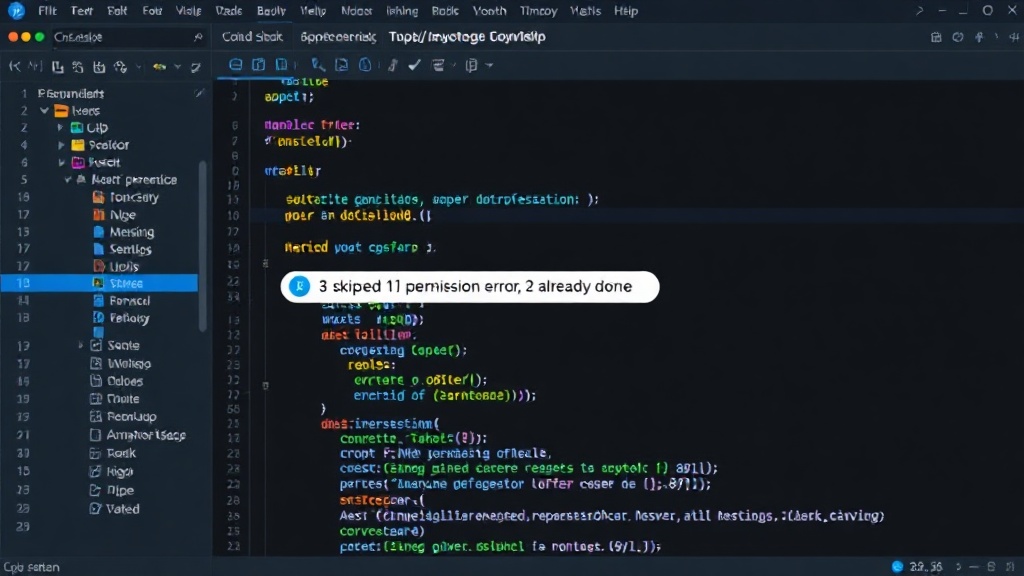
This level of detail transforms a vague status update into an actionable alert. Operators can then prioritize their efforts. If "not permitted" is the dominant reason, they know to investigate permissions. If "already processed" is the reason, they can be confident the system handled those items correctly and move on. This clarity is essential for maintaining operational efficiency and trust in the system's feedback mechanisms.
The Warning: A Run That Changed Nothing
Beyond the specific skip reasons, there's a subtler, yet equally critical, issue: a bulk operation that results in zero changes. Even if every single skip was legitimate and expected, a "run completed successfully" message when nothing actually changed is misleading. The operator requested an action, and the system reported completion without any modification. This can create a false sense of security. A green toast that says "Operation Complete" after zero items were modified can be interpreted as "everything is fine, nothing needed doing," when in reality, the operator intended for something to happen, and the system's inaction is a potential indicator of a deeper problem or misconfiguration.
Consider the implications. If an operator initiates a bulk action to, say, enable a feature for a set of users, and the system reports success but no users were enabled, this is a critical failure. It could mean the feature flag system is broken, the user targeting logic is flawed, or the operation itself has a bug that prevents any changes from being applied. In such cases, a "success" message is not just unhelpful; it's actively harmful, masking a problem that could have significant consequences.
A more robust system would flag such scenarios. If a bulk operation completes and zero items were modified, even if all skips were valid, it should be presented as a warning, not a success. This could be a yellow status indicator, a specific message like "Operation completed, but no items were modified. Please review," or a prompt to investigate further. This approach acknowledges that while the system may have executed without errors, the *outcome* of the operation was null, which warrants attention.
Underlying Technical Details and Caveats
It's important to understand the context in which these bulk operations occur. In many systems, selections for bulk actions are keyed on public, client-writable identifiers like UUIDs, rather than internal, auto-incrementing IDs. This is often a design choice to allow for more flexibility and to decouple client-side selections from server-side database specifics. However, it also means that the integrity of the selection itself relies on these public identifiers being correctly managed and unique.
A more insidious bug, as highlighted by one operator's experience, can occur when job dispatching fails. The scenario described involved a toast message indicating "3 deployments stopping," yet all three jobs remained unclaimed in the queue table. The root cause? The jobs were dispatched to a queue that no worker process was actively listening to. This is a critical failure in the job processing pipeline, where the system *believes* it has handed off work, but the work never reaches its intended consumer. The user sees a message about work being stopped, but the work was never started or picked up. This highlights the need for end-to-end monitoring of job queues and worker health, not just the dispatch mechanism.
In summary, moving beyond a simple "X skipped" message to granular, reason-specific feedback is essential for any operational tool. Furthermore, systems must differentiate between a successful operation that modified data and an operation that resulted in no changes, even if technically error-free. These improvements empower operators, reduce guesswork, and build trust in the system's reliability and reporting capabilities.