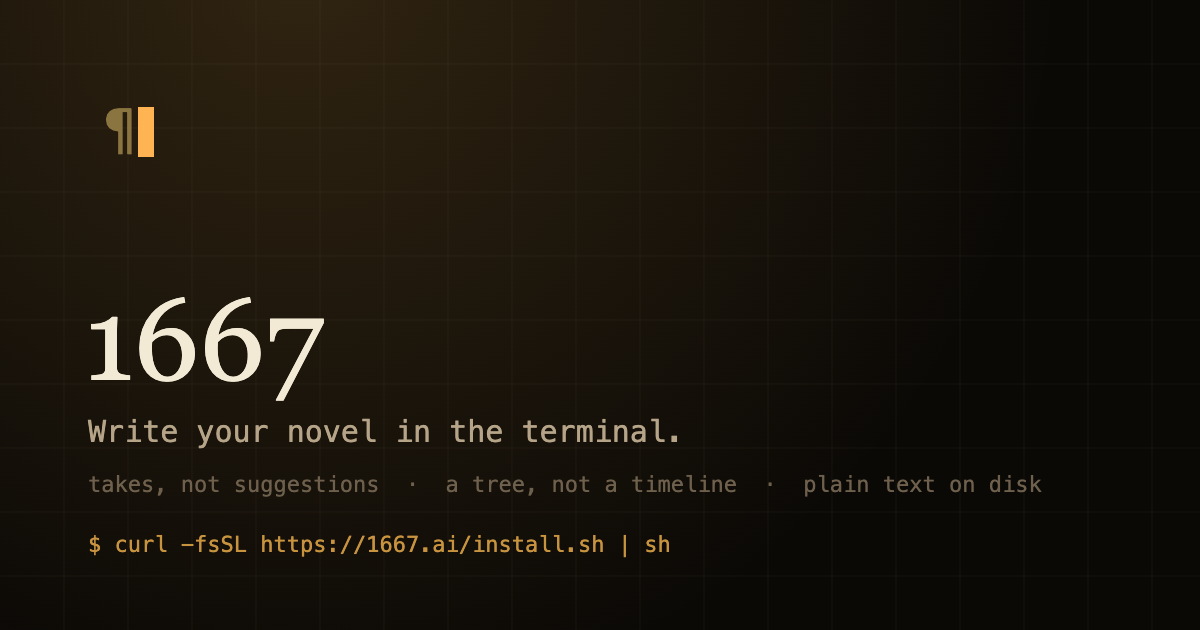
A Focused Writing Environment
A new tool called 1667 has emerged, aiming to provide fiction writers with a dedicated, terminal-based user interface for interacting with large language models (LLMs). The project, shared on Hacker News under the 'Show HN' tag, positions itself as an alternative to the often cluttered and distracting web-based interfaces common in AI writing assistance.
The core concept behind 1667 is to strip away visual distractions and provide a clean, keyboard-centric experience. For writers who find themselves battling pop-ups, excessive formatting options, and the general allure of infinite browser tabs, a terminal environment can be a powerful tool for deep work. It’s akin to returning to a focused writing room, but with the added capability of a sophisticated AI co-author at your fingertips.
1667 leverages LLMs to assist in various aspects of the fiction writing process. This can range from generating plot ideas and character descriptions to drafting specific scenes or suggesting alternative phrasing. The terminal interface means users interact with these powerful models through text commands and receive text-based output, fostering a more direct and less mediated creative flow.
Interacting with Language Models
The utility of 1667 hinges on its ability to seamlessly integrate LLM capabilities into a writer's workflow. Instead of copy-pasting prompts into a separate web application, writers can potentially draft, iterate, and refine their work all within the same terminal window. This direct interaction is key to maintaining momentum and preventing the creative spark from being extinguished by context switching.
For developers and technically inclined writers, the appeal of a terminal UI is often its efficiency and customizability. Command-line tools are typically lightweight and can be integrated with other scripting and automation tools. This opens up possibilities for advanced workflows, such as batch processing of text, custom prompt engineering pipelines, or even integrating 1667 with version control systems for tracking creative drafts.
The project's name, 1667, might evoke a sense of historical writing tools, perhaps hinting at a desire to return to fundamental principles of composition while embracing modern AI. The terminal itself, a long-standing staple of computing, provides a familiar and powerful canvas for this new application of AI in creative pursuits.
The Appeal of Minimalism in AI Writing
The current landscape of AI writing tools is dominated by feature-rich web applications. While these offer accessibility and a wide range of functionalities, they can also become overwhelming. 1667’s minimalist approach is a deliberate counterpoint, prioritizing immersion and focus. Think of it less like a sprawling digital word processor and more like a highly responsive, AI-powered typewriter that can instantly offer plot twists or character dialogue on command.
This terminal-centric design is particularly suited for writers who are already comfortable with command-line interfaces for coding or system administration. It lowers the barrier to entry for using advanced AI models in their creative process, provided they are willing to embrace the text-based paradigm. The output from the language models can be directly incorporated into the ongoing text, edited, or used as inspiration for the next piece of writing.
The project's presentation as a 'Show HN' suggests it's an ongoing development, likely with contributions and feedback from the Hacker News community shaping its future. The core value proposition remains clear: a streamlined, powerful way for fiction writers to harness the capabilities of language models without the bloat of traditional graphical interfaces.
Potential Workflows and Future Directions
Writers using 1667 could establish workflows where they use the tool for brainstorming sessions, generating first drafts of challenging scenes, or overcoming writer's block. The AI can act as a tireless collaborator, offering suggestions that a human partner might not, or providing variations on a theme that would take a human writer hours to explore.
For instance, a writer could prompt 1667 to describe a character's reaction to a dramatic event, then use the generated text as a starting point. They could then ask the AI to rephrase the reaction from a different character's perspective, or to expand on the emotional subtext. The terminal interface ensures this iterative process remains fluid.
What nobody has addressed yet is how 1667 might integrate with existing professional writing tools like Scrivener or Ulysses. A seamless export or even a plugin that allows bidirectional syncing would elevate its utility for writers already invested in established ecosystems. The current focus on a standalone terminal experience is powerful for isolation, but broader integration could unlock its full potential for professional authors.
The project represents an interesting intersection of AI, developer tooling, and creative writing. By focusing on a minimalist, terminal-based interface, 1667 carves out a niche for writers who value focus and efficiency, offering a different path to AI-assisted storytelling.