The Abstract Unit: 1 Million Tokens
Large language models (LLMs) are rapidly expanding their context windows, with "1 million tokens" becoming a common specification. However, for most humans, a raw number like 1,000,000 tokens is abstract and fails to convey the sheer volume of information it represents. This abstractness makes it difficult to grasp the practical implications of such a large context window for real-world applications and user experiences.
To bridge this gap, an interactive site called "One Million Tokens" aims to visualize this massive scale in human-understandable terms. It transforms the abstract numerical value into tangible comparisons, allowing users to intuitively grasp the capabilities of models with such extensive memory.

Translating Tokens to Tangible Scale
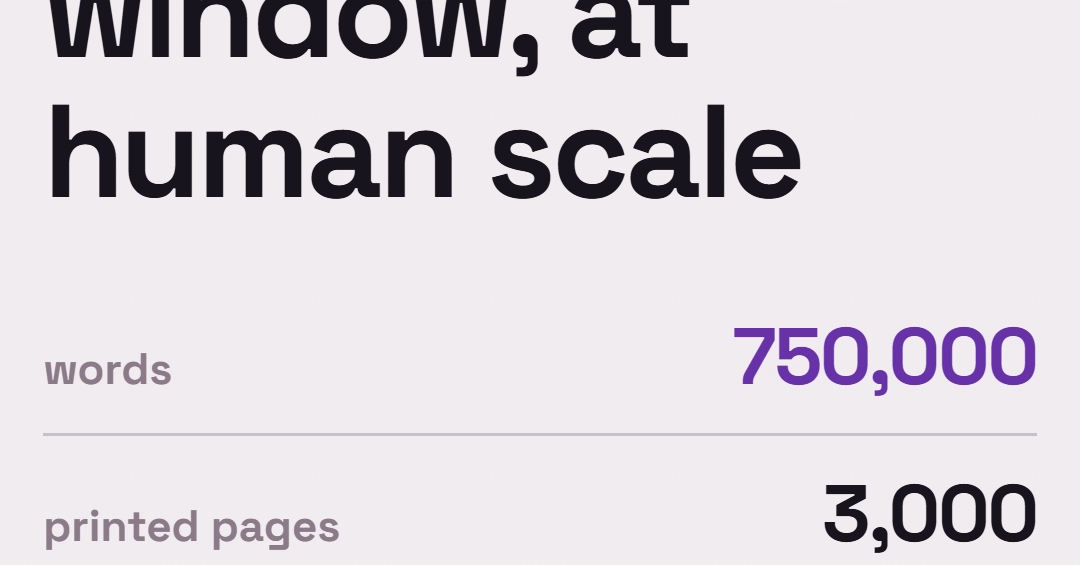
The "One Million Tokens" site provides several key conversions to make the scale comprehensible:
- Words: Approximately 750,000 words. This is roughly equivalent to a substantial library of novels.
- Printed Pages: Around 3,000 printed pages. Imagine a stack of paper that high – it dwarfs typical document sizes.
- Conversation Time: Roughly 83 hours of continuous conversation. This is more than three full days of non-stop talking.
- Lines of Code: Approximately 75,000 lines of code. This is enough to represent a significant portion of a large software project.
These figures are not intended to be exact universal measures but rather intuitive benchmarks. The goal is to provide a visceral understanding of how much information a model can process and retain in a single interaction.
The Evolution of Context Windows
The site also contextualizes this massive leap by tracing the history of context window growth in prominent LLMs. From early models like GPT-3, which had significantly smaller context windows, the progression has been exponential. Each iteration has pushed the boundaries, enabling models to handle longer documents, more complex conversations, and larger codebases. This historical perspective highlights not just the current achievement but also the rapid pace of development in the field.
Consider GPT-3's initial context window, often cited around 2,000 tokens. This was a breakthrough at the time, allowing for basic multi-turn conversations and short document summarization. Subsequent models like GPT-3.5 and GPT-4 saw this increase to 4,000, 8,000, 32,000, and even 128,000 tokens. The jump to 1 million tokens represents a nearly 8x increase over the largest widely available context windows just a year or two prior. This isn't just an incremental improvement; it's a qualitative shift in capability.
Practical Implications for Users and Developers
A 1 million token context window fundamentally changes what's possible with LLMs. For developers, it means they can build applications that process entire books, extensive legal documents, or massive code repositories in a single prompt. This enables richer analysis, more coherent long-form content generation, and sophisticated retrieval-augmented generation (RAG) systems that can draw from vast amounts of data without complex chunking strategies.
For end-users, this translates to more natural and extended conversations with AI assistants. Imagine an AI that can remember every detail of a multi-day project discussion, or one that can read and reference an entire technical manual to answer your questions. The conversational memory becomes orders of magnitude deeper, reducing the need for users to repeat information or re-contextualize their queries.
This capability is akin to giving an AI a photographic memory for an entire library, rather than just a sticky note. It allows for a much more profound understanding of user intent and a more comprehensive response generation. The AI can maintain a consistent persona, follow intricate plotlines in creative writing, or analyze complex financial reports with unprecedented detail.
The Challenge of Human Scale vs. Token Scale
The core problem the "One Million Tokens" site addresses is the mismatch between computational units (tokens) and human perception. While developers and researchers understand tokens as discrete units of text or code, the average user interacts with information as words, pages, or hours of experience. The site's visualizations are crucial for making the advancements in LLM technology accessible and understandable to a broader audience.
This difference in perception is critical. For instance, 75,000 lines of code is a quantity that a seasoned software engineer can immediately appreciate as a substantial codebase. Similarly, 3,000 printed pages signifies a significant volume of written material. By mapping these abstract token counts to relatable quantities, the site demystifies the technology and highlights its growing power.
Future Outlook and Unanswered Questions
The rapid expansion of context windows raises new possibilities and challenges. As context windows grow, so does the computational cost, both in terms of training and inference. Efficiently processing and retrieving information from such vast contexts without significant latency is a major engineering hurdle. Furthermore, while models can now *see* more, their ability to *reason* effectively across the entirety of that context is still an active area of research. What happens when a critical piece of information is buried deep within a 1 million token context, and the model fails to surface it due to attention mechanism limitations or inherent biases?
The development of tools like "One Million Tokens" is vital. It not only educates the public but also serves as a benchmark for developers to understand the practical limits and potential of these new model capabilities. As context windows continue to expand, these human-scale visualizations will become even more critical for assessing true progress and managing expectations.